
It's Friday at 6 p.m. A salon owner has eight independent stylists renting booth space, and she owes each of them their cut before the weekend. Her merchant account shows the day's sales. Her bank account doesn't, until Monday's batch settles Tuesday.
Multiply that scenario across every merchant who runs payroll, pays subcontractors, or just wants to breathe easier over a bank holiday, and you have a liquidity gap that traditional settlement timing was never built to close.
Merchants already expect someone to solve this
Faster access to funds used to be a nice-to-have. It isn't anymore. Merchants see same-day and instant options everywhere else in their financial lives, and they've started asking their payment processor why they can't get the same thing on the account they already use every day.
That expectation creates real risk for payment companies: if you don't offer a way to close the gap, a competitor — or a fintech with no processing relationship at all — will. And once a merchant starts routing liquidity needs somewhere else, the rest of the relationship gets easier to walk away from too.
What Instant Payouts actually is
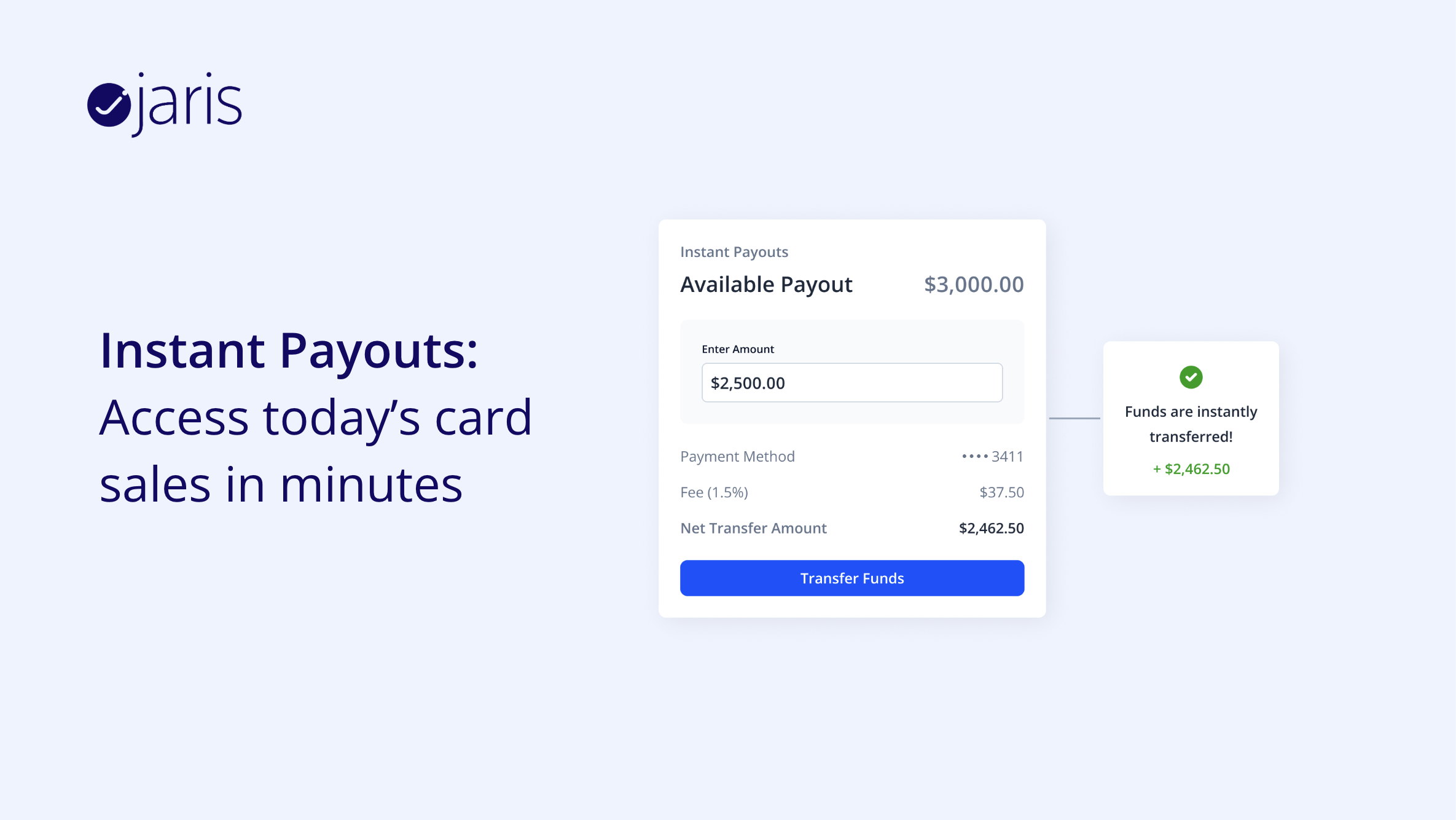
Instant Payouts give merchants access to their current-day sales before the standard batch-and-settle cycle completes. As a merchant processes transactions throughout the day, they see an available balance grow in real time. At any point, they can transfer some or all of that balance to their bank account for a small fee, and the funds move immediately, including nights, weekends, and holidays.
A few things worth being precise about, because "Instant Payouts" gets used loosely in this market:
It's not a loan. Merchants are accessing money they've already earned through transactions they've already processed, not borrowing against future sales.
It doesn't require a new bank account. Funds land wherever the merchant already banks — no need to move relationships or add a new login.
It's opt-in and on-demand. Merchants use it when they need it (most commonly weekends, holidays, and payroll days), not on a fixed schedule.
Why this isn't just "another embedded finance feature"
Payment companies have plenty of embedded finance options to evaluate, and not all of them are worth the integration effort. Lending is a good example: it's a strong product, but not every merchant needs a loan at a given moment, so adoption is naturally narrower.
Liquidity is different. Nearly every merchant, across nearly every vertical, has felt the weekend or holiday cash crunch at some point. That's what makes instant payouts a broader-reach product than most embedded finance add-ons — and why it tends to be one of the faster paths to meaningful adoption across a merchant portfolio.
"Instant Payouts allows our ISO and Agent partners in the U.S. card-present SMB space to drive new revenue and increase retention, while solving a critical liquidity gap for merchants.”
– Tyler Nowell, SVP of SMB Sales at Paysafe
What's next in this series
In Part 2, we'll go under the hood: how enrollment and eligibility work, how the available balance is calculated, and how repayment happens without adding settlement lag to a merchant's normal funding schedule.
In Part 3, we'll cover the part that matters to your P&L: the revenue model, the retention case, and what a realistic implementation timeline looks like.
If you're evaluating whether a liquidity product belongs in your portfolio, that's the right question to start with — not "can we build this" but "what happens to our merchants if we don't."
To learn more about partnering with Jaris, contact us.